
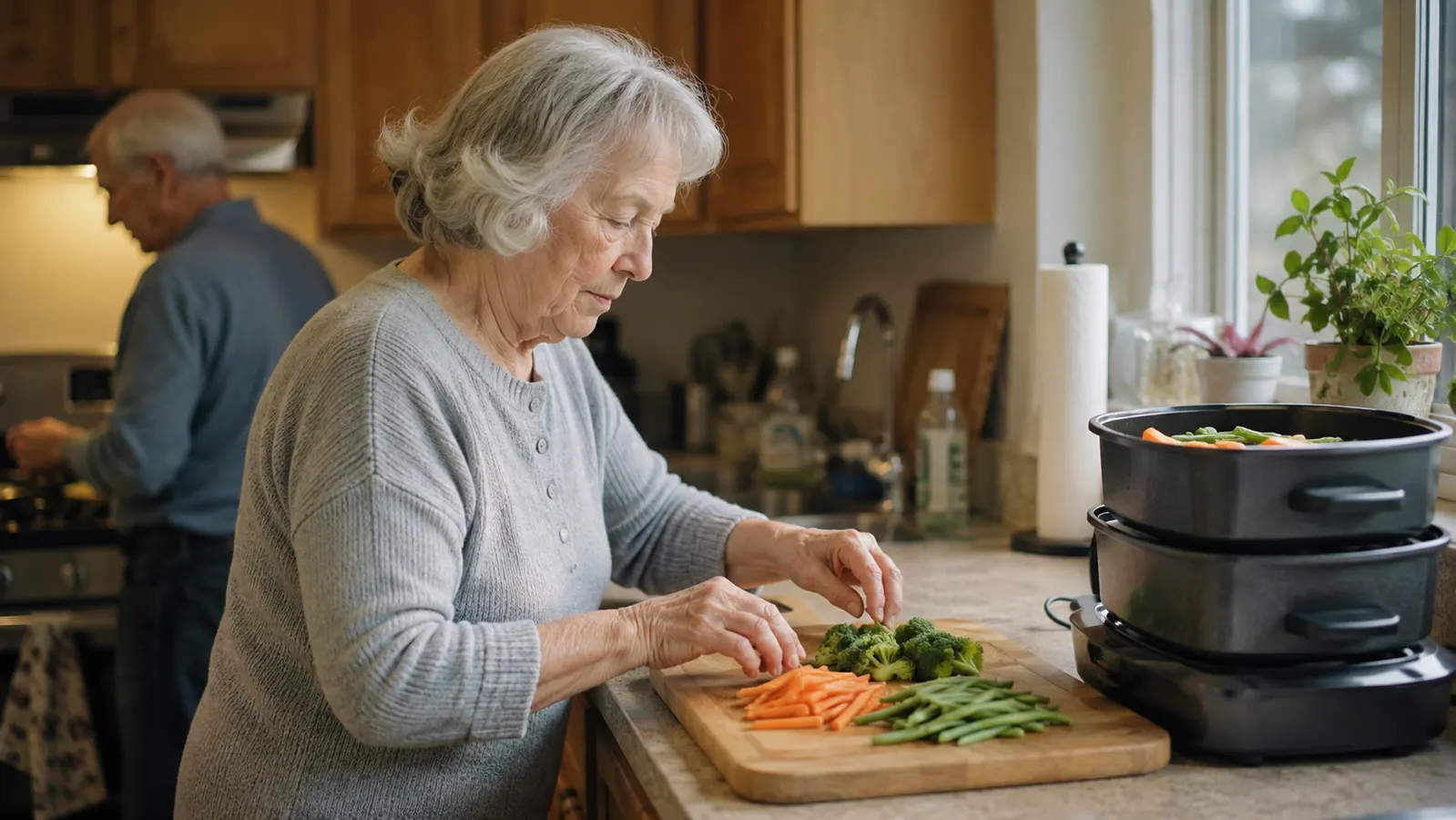
For years my steamed vegetables came out one of two ways, either the broccoli was done and the carrots underneath were still hard, or everything sat too long while I got distracted and came back to a soft, gray mess. I finally worked out that the problem was never the vegetables. It was that I was not cutting, loading, or timing them with any real method, just guessing and hoping. Since I started using my BELLA Two Tier Food Steamer with an actual routine instead of a shrug, that guesswork mostly went away, and this is the exact order I follow now, start to finish.
None of these five steps require anything fancy. What they require is doing them in order and not skipping the boring ones, because the boring ones, cutting evenly and checking doneness properly, are the two things that actually decide whether dinner turns out right. I will also walk through what goes wrong when one of these steps gets skipped, since I have made every one of those mistakes myself at some point on my own counter.
I care about getting this right for a fairly ordinary reason. My husband and I eat vegetables most nights, and when my daughter and her family come for Sunday dinner, a big tray of unevenly cooked carrots and mushy broccoli is not something I want to serve. Having a method I can rely on, rather than hovering over the stove hoping for the best, has made vegetables one of the parts of dinner I no longer worry about.
Tired of Guessing at Timing and Getting Mushy Vegetables Anyway?
A two tier steamer with a clear lid and a fill line takes most of the guesswork out of this whole process, which is a big part of why I reach for mine most weeknights now. Check today's price and current availability on Amazon.
Amazon Check Today's Price on Amazon →Step 1: Cut Everything to One Size Before It Ever Touches the Basket
This is the step I used to skip, and it is the one that causes the most trouble. If some carrot pieces are the size of a quarter and others are twice that thick, the thin ones finish steaming well before the thick ones do, and by the time the thick pieces catch up, the thin ones have gone past done into mushy. The fix is simple but takes a bit of patience with the knife. I cut carrots and potatoes into pieces roughly the same thickness, usually about half an inch, and I try to keep broccoli florets to a similar size to each other, breaking the larger ones down rather than leaving a mix of small and oversized pieces in the same batch.
Green beans and asparagus are more forgiving since they are already a fairly uniform shape, but I still snap or trim off any noticeably thicker ends so the whole batch cooks at closer to the same rate. It takes me maybe two extra minutes at the cutting board, and it is the single biggest reason my vegetables come out evenly cooked now instead of half hard and half falling apart.
I do not measure with a ruler, that would be overkill for a weeknight side dish. What I do is lay the cut pieces out on the board for a second before loading the basket and eyeball them side by side, pushing aside anything that is clearly bigger or thicker than the rest so it can be recut or added to a second, longer cooking batch. It is a quick habit once you get used to it, and it costs almost nothing in extra time.
Step 2: Load the Lower Tier With What Needs the Most Heat
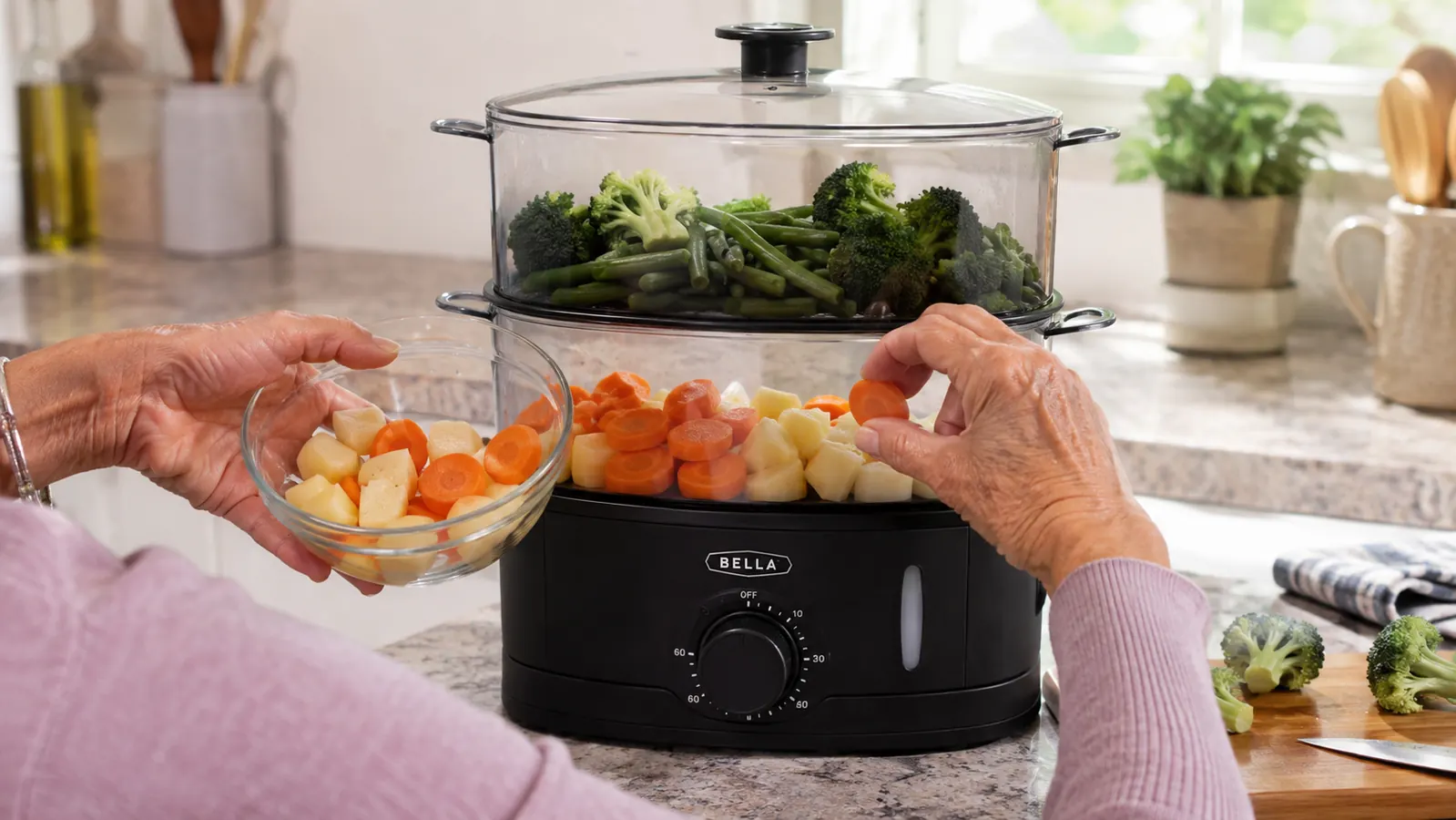
A two tier steamer is not just a way to cook more food at once, it is also a way to cook different vegetables at their own pace if you load it thinking about where the steam is strongest. The lower basket sits closer to the water and the heating plate, so it gets the most direct, steady steam. That is where I put root vegetables and anything dense, sliced carrots, cubed potatoes, small chunks of squash, the things that genuinely need more time and more heat to soften all the way through.
The upper tier gets steam that has already passed through the lower basket, so it runs a little gentler by the time it reaches whatever is up there. That is where delicate, faster cooking vegetables belong, broccoli florets, green beans, asparagus, anything I do not want to overcook while I am waiting on the sturdier vegetables underneath. Fish and thin cuts of anything, if I am steaming a protein alongside the vegetables, also go on top for the same reason.
For the water itself, I fill the reservoir to the marked line rather than eyeballing it, usually somewhere around two cups depending on how long the cook will run. I also do not crowd either basket. If the vegetables are piled two or three layers deep instead of spread in roughly one layer, the steam cannot move around them evenly, and the pieces on the bottom of the pile end up undercooked while the top layer overcooks. When I have more to steam than fits comfortably in one layer, I run a second short batch rather than stacking everything into one crowded basket.
Step 3: Set the Timer for What You Actually Loaded, Not a Guess
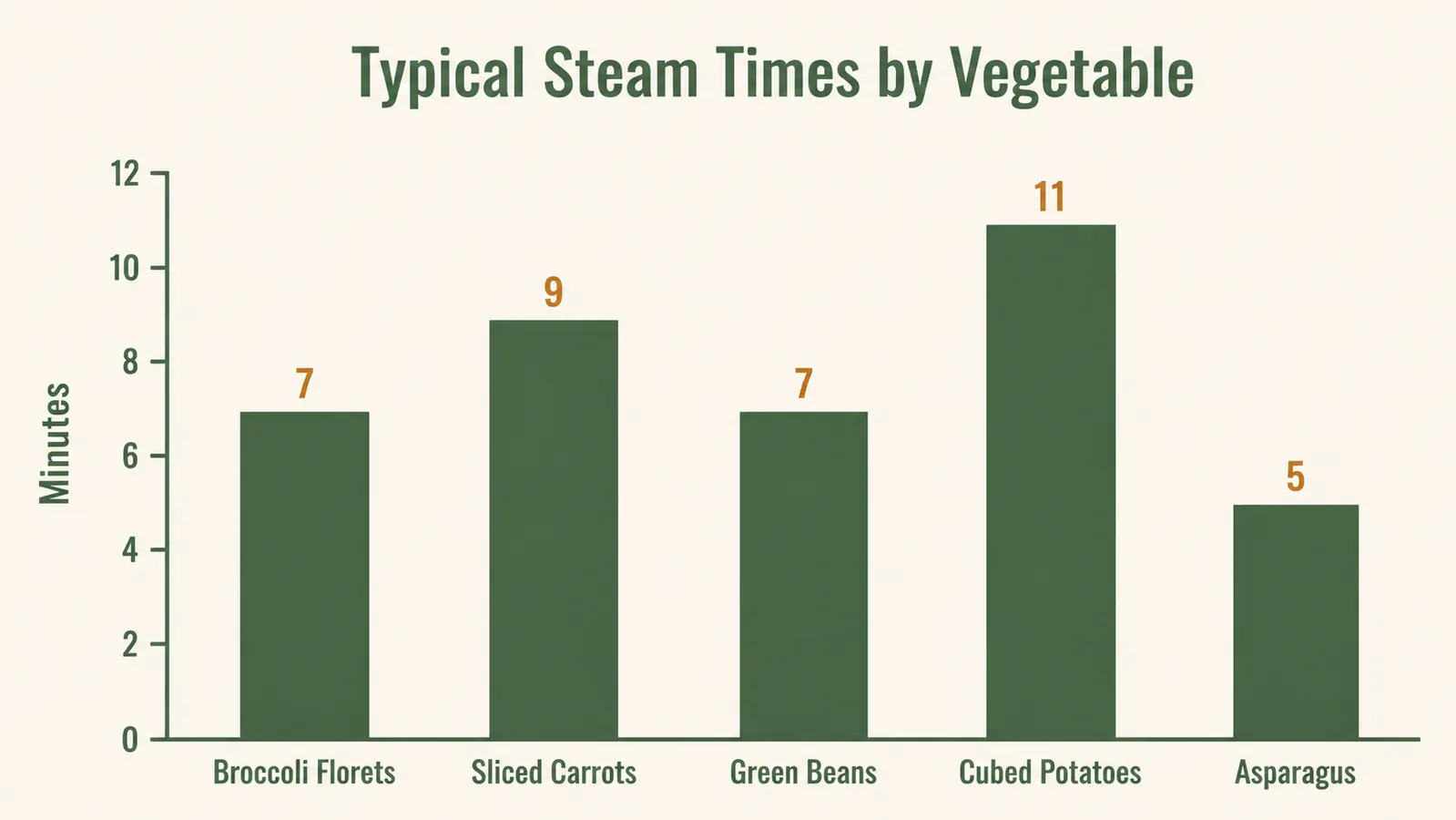
This is where cutting things evenly in step one finally pays off, because it means I can trust a timer instead of poking at random pieces the whole time. For vegetables cut to roughly the sizes I described above, my rough times are broccoli florets around seven minutes, sliced carrots around nine minutes, green beans around seven minutes, cubed potatoes around eleven minutes, and asparagus around five minutes. Those numbers are not exact for every kitchen or every steamer, but they are close enough to start a timer with instead of guessing blind.
When I am running a mixed load, potatoes on the bottom and broccoli on top, I set the timer for the longer vegetable and add the shorter cooking one partway through instead of loading both baskets at once. So potatoes go in first, I let them run for about four minutes on their own with the upper basket empty, and only then do I add the broccoli on top for the remaining time. It is a small extra step, but it is how I finally stopped getting one perfectly cooked tier and one mushy or undercooked tier in the same meal.
These times also shift a little depending on how full each basket is. A single layer of broccoli spread loosely will finish closer to the low end of that range, while a fuller basket, even one still spread in a single layer, tends to run closer to the high end. I treat my times as a starting point for the timer, not a rule carved in stone, and I always plan on checking a minute or two before I expect things to be done rather than waiting for a buzzer I set once and forgot about.
Step 4: Test for Doneness Before You Trust the Timer Completely
A timer gets me close, but it is not the final word, since stove voltage, how full the basket is, and even how cold the vegetables were going in can all shift the actual time by a minute or two. In the last minute or so, I lift the lid carefully, away from my face since the steam that escapes is genuinely hot, and pierce a fork into the thickest piece in each tier, usually a carrot round or a potato cube.
What I am looking for is a fork that slides in with a little resistance still there, not one that meets no resistance at all. If the fork goes in with zero effort, the vegetables have already gone soft and are on their way to mushy. If it barely goes in at all, they need another minute or two. The clear lid on my steamer helps here too, since I can often see the color change, brighter green on broccoli and green beans, before I even lift it to check with a fork.
Step 5: Pull Them the Moment They're Done, Not a Minute Later
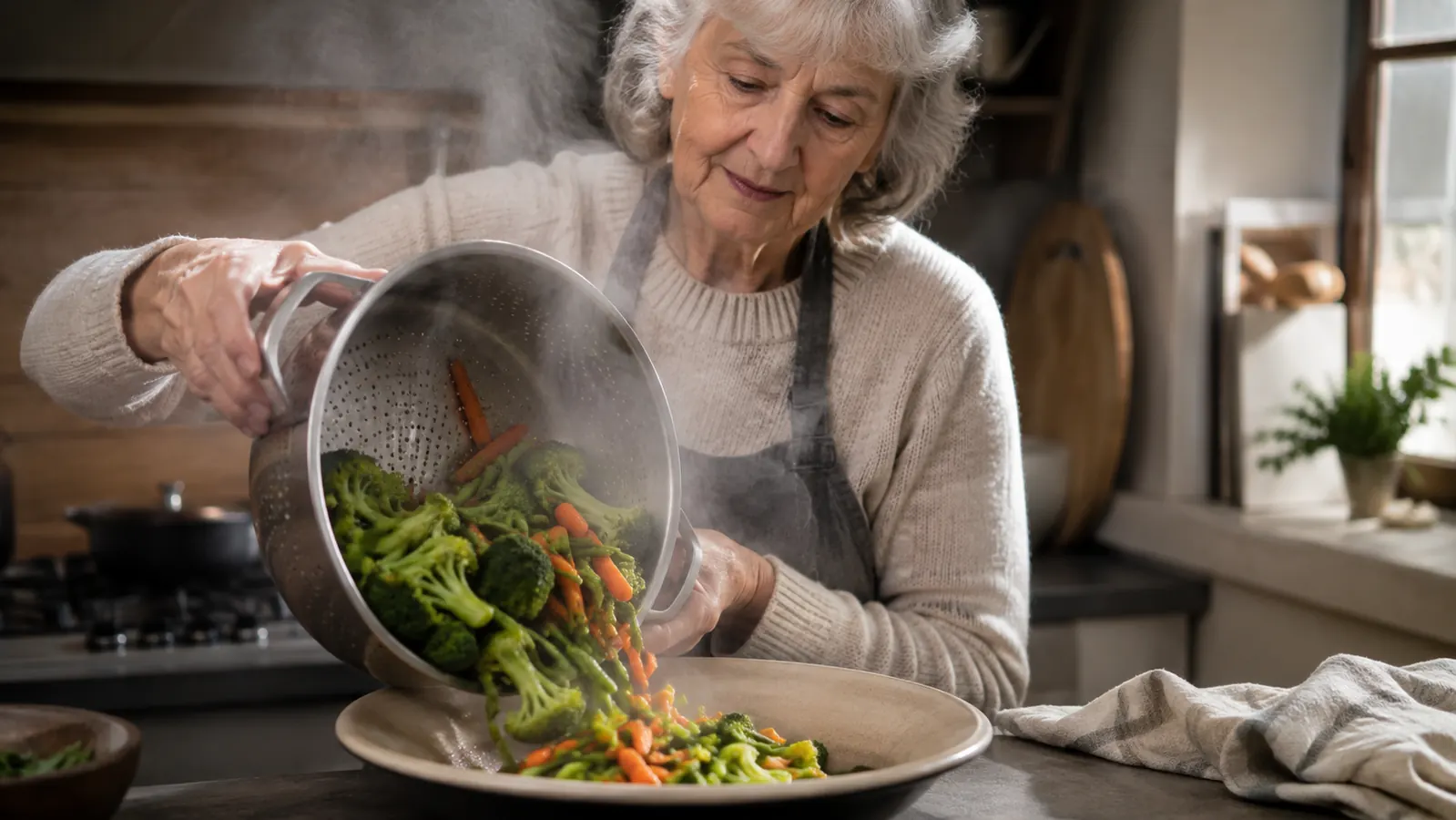
Vegetables keep cooking from their own residual heat even after you turn the steamer off or lift the basket out, which is exactly how a batch that looked perfect at the fork test ends up soft and gray five minutes later on the plate. The moment mine test done, I move fast. I tip the basket out onto a wide plate or into a shallow bowl and spread everything into a single layer right away, rather than leaving it piled in the hot basket where trapped heat keeps working on it.
Spreading them out lets the heat escape into the air instead of staying trapped against the vegetables, and it is a simple habit that has made a real difference for me. If I am prepping ahead for later in the day, I will sometimes go a step further and run the vegetables briefly under cold water or into a bowl of ice water right after steaming, which stops the cooking almost instantly and keeps the color bright. For dinner going straight to the table, spreading them out on a plate is usually enough.
It is also worth saying plainly, since it is part of why I moved to a steamer basket in the first place, that steaming keeps the vegetables out of the cooking water rather than sitting and boiling in it the way a pot of water on the stove works. I am not going to make bigger claims than that about what it does or does not preserve. I just know it changed how my vegetables look and taste compared to the boiled ones I grew up eating, and that has been enough of a reason for me to stick with it.
What Else Helps
Most of the vegetable mistakes I made before I had a real method trace back to one of three things. Mushy vegetables almost always meant I left them in too long after they were already done, usually because I walked away instead of testing early. Uneven batches almost always meant I had mismatched sizes in the basket or crowded too much into one layer. And more than once, I let the reservoir run low mid-cook because I filled it by eye instead of to the marked line, which is the one mistake a two tier electric steamer actually helps prevent, since mine shuts itself off rather than letting the base run dry.
I also keep a small notepad on the fridge with the rough times I listed above, since I still forget them between uses and it saves me from guessing every single time. If your reservoir has ever run dry mid-cook on a stovetop setup, refilling with hot water from the kettle rather than cold from the tap keeps the steamer from losing its rhythm as badly, since it does not have to spend the first few minutes just getting back up to temperature. I go into more detail on how the auto shutoff and boil dry protection have held up for me over months of regular use in my long-term review of the BELLA Two Tier Food Steamer, and if you are trying to decide whether an electric steamer is worth adding to your counter at all, I laid out the honest comparison in BELLA steamer versus stovetop steaming.
The steamer did not fix my timing for me. Cutting evenly, loading by tier, and testing early did that. What the steamer gave me was a machine that does not quietly ruin dinner the one time I get distracted.
Ready to Stop Guessing and Start Steaming on a Real Schedule?
Once you have a two tier basket, a fill line, and an auto shutoff working with this method instead of against it, evenly cooked vegetables stop being a coin flip. Check today's price on Amazon and see if it's currently in stock.
Amazon Check Today's Price on Amazon →