
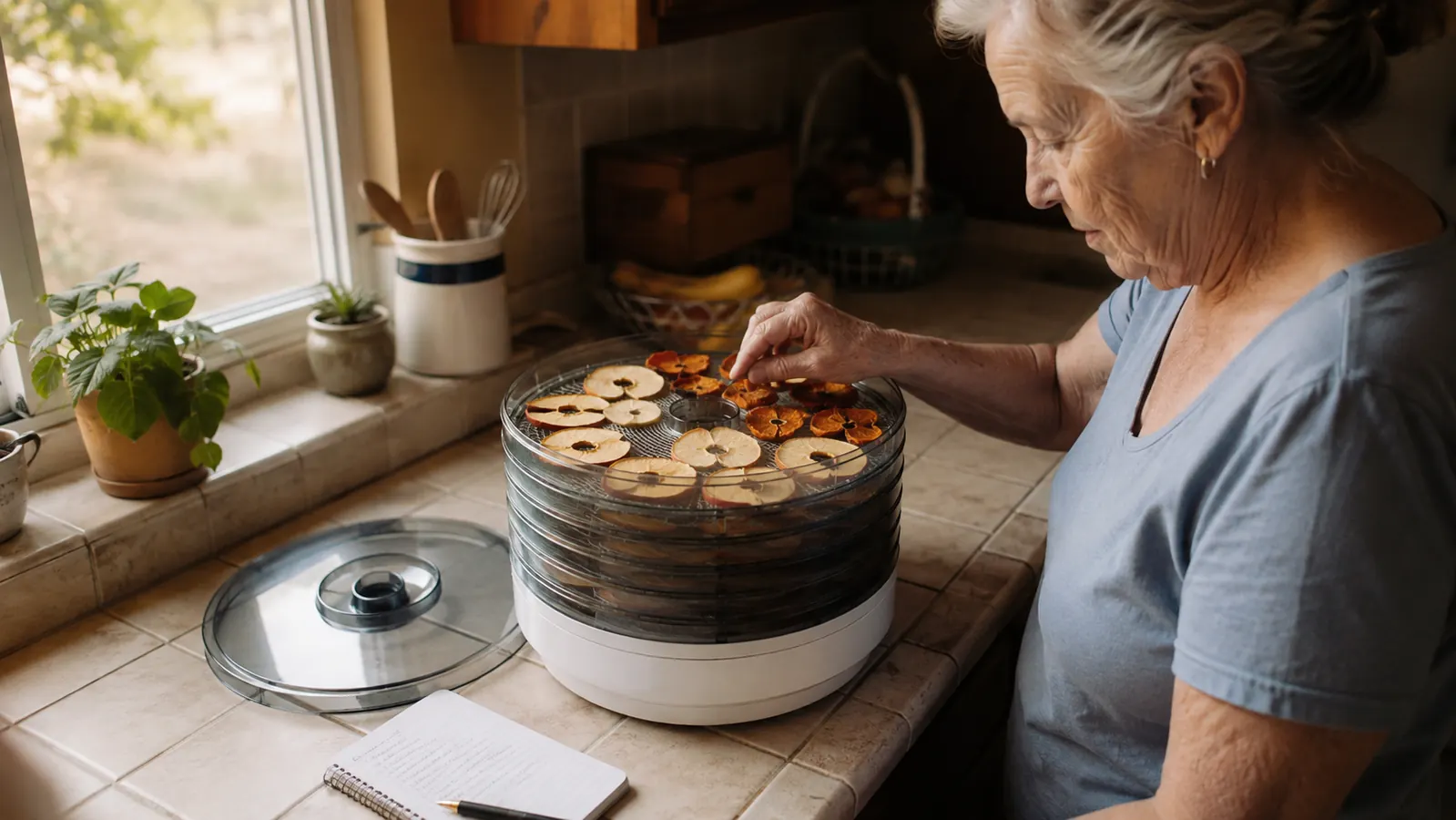
I read every review I could find before I bought the Presto Dehydro Electric Food Dehydrator, probably forty or fifty of them stacked up over a rainy weekend, and almost all of them said some version of the same three things: it's quiet, it's easy, it just works. Nobody mentioned that my first batch of zucchini would come out crispy on top and still limp and cool to the touch on the bottom tray, or that I'd end up standing in my kitchen at eleven at night trying to decide whether the trays needed swapping or whether I'd simply bought a broken machine. I hadn't bought a broken machine. I'd bought the ordinary version of an appliance that, once you understand its habits, does exactly what it promises. This is the honest account of getting there, the parts the glowing reviews leave out.
I've already written a full six-month, two-season account of what this dehydrator has actually dried and how it's held up, if that's what you're after. This piece is different, and shorter on purpose. This is what I wish someone had told me in plain language before I clicked buy, the parts about the first bad batch, the trays I ended up buying a second time, the run time that stretched past a full day, and the two moments in that first month when I genuinely considered taping the box back shut and sending it back. I get into how the whole decision started in the story of why I finally bought one, if you want that context too.
The Quick Verdict
This machine works, and I still reach for it most weeks, but it asks you to learn its habits the hard way unless somebody tells you first. Go in expecting a simple, set it and forget it appliance the way the photos suggest, and the first two weeks will frustrate you more than they should.
Amazon Check Today's Price →Before You Add This to Your Cart, Here's What the Five-Star Reviews Leave Out
The Presto Dehydro dries a whole counter's worth of garden produce for a fraction of what a bigger machine costs, but it comes with a real learning curve the listing photos don't show. See today's price and current availability on Amazon before you decide.
Amazon Check Today's Price on Amazon →The Gap Between the Product Photos and My First Batch
The listing photos show this dehydrator sitting on a bright, spacious counter with six neat trays fanned out like a magazine spread, and there's a clean simplicity to the design that appealed to me right away. No dial, no digital screen, no buttons to figure out. Plug it in and it runs. I read that as a feature before I owned it, one less thing to fuss with on a machine I already worried would be one more gadget cluttering my three feet of counter space. I even mentioned to my husband how relieved I was that there was nothing complicated to learn.
What I did not understand until my first real batch is that the simplicity is also the whole limitation. There is nothing on this machine that adjusts to what you're drying, how thick you sliced it, or how full the trays are loaded. It runs at one fixed temperature no matter what, and the outcome depends entirely on decisions I had to make myself, mostly by trial and error, in that first week. Nothing in the description said this plainly, not even in the fine print of the specifications. I had to learn it by getting a batch wrong and standing in my kitchen wondering what I'd done.
I don't think that makes the design dishonest exactly, but I do think the clean, dial-free look in the photos reads as more forgiving than the machine actually is. A dehydrator with a temperature dial and a digital timer costs more and looks fussier, but it also tells you plainly, just by the way it looks, that drying food takes some tending. This one lets you assume it's simpler than it is, right up until your first tray comes out wrong and you're left guessing why.
Why My First Batch Came Out Wrong
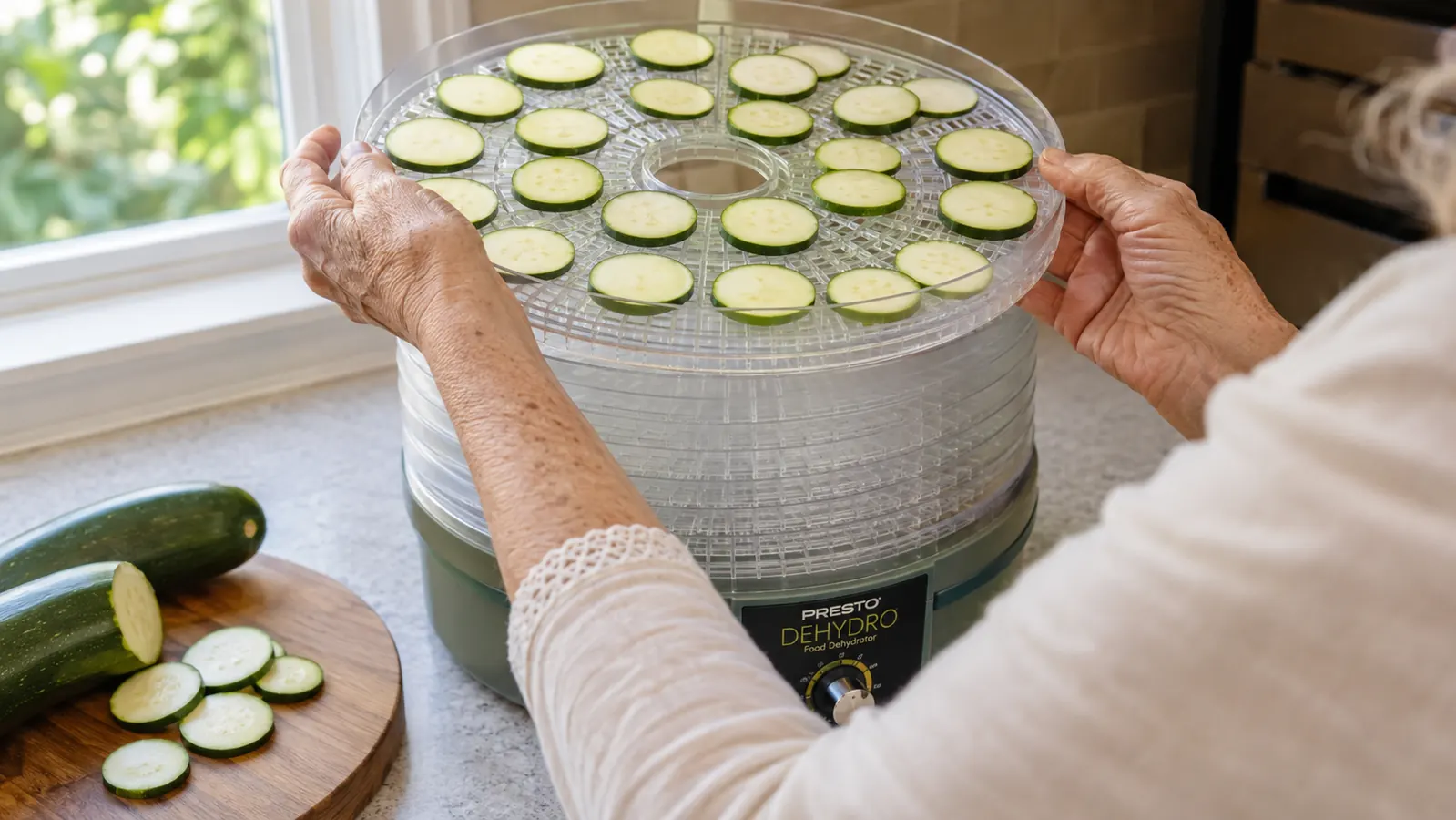
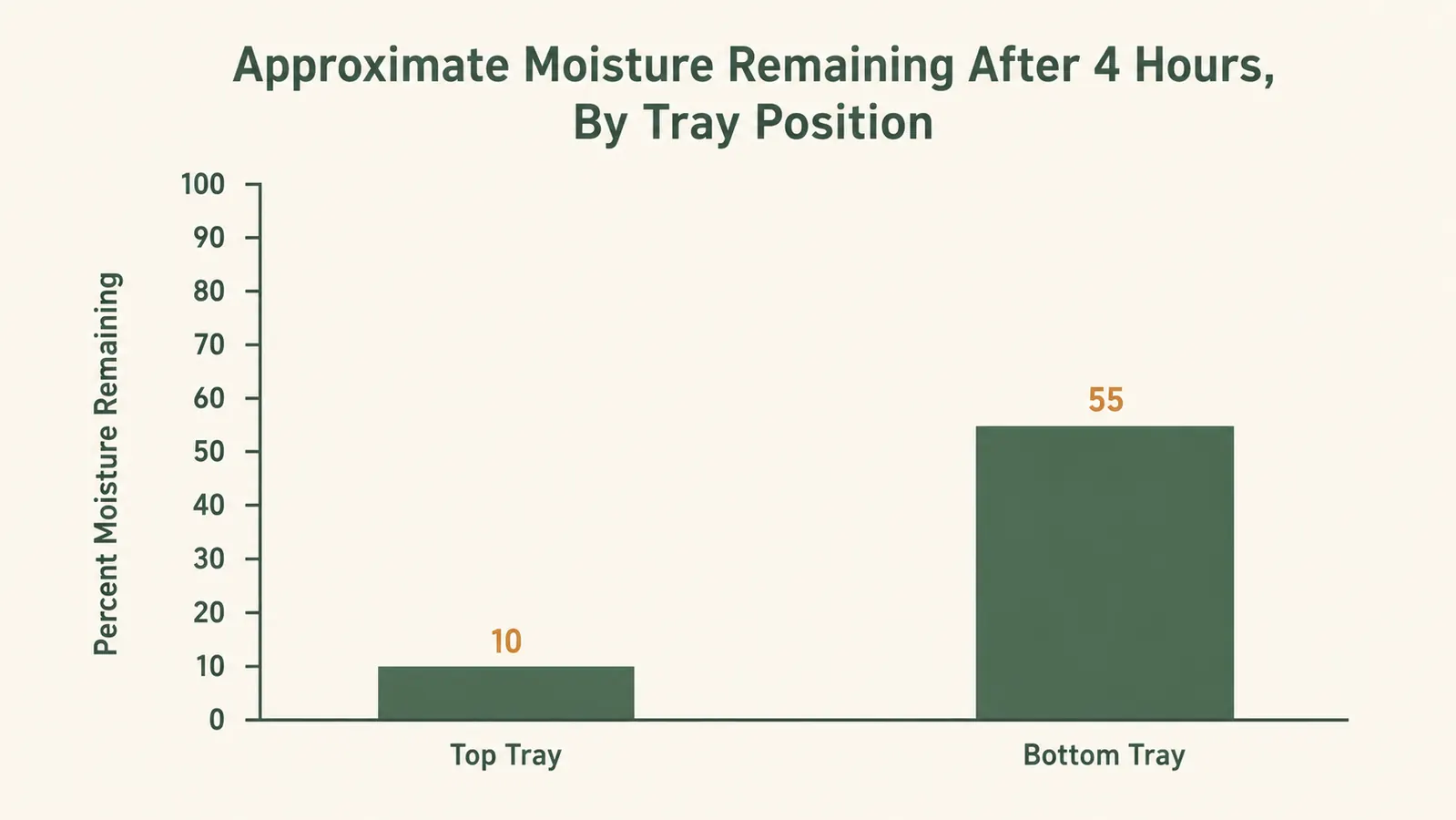
I loaded all six trays with zucchini I'd sliced as evenly as I could manage with a regular kitchen knife, set it running before bed, and expected to wake up to six trays of the same result. Instead the top tray, closest to the motor and fan built into the lid, was crisp and fully dry by morning. The bottom tray, farthest from the warm air coming down through the stack, was still cool, slightly limp, and nowhere close to done. I genuinely thought something was wrong with the unit, and I remember standing there with a cup of coffee, turning the base over to check for some obvious flaw.
It took some digging through owner forums, not the product page or the included instructions, to understand why. The fan sits at the top and pushes warm air down through all six trays in sequence, which means the air reaching the bottom tray has already given up some of its heat and picked up moisture from the trays above it. That's simply how this stacked design works, and it's not unique to this particular unit or a sign of a manufacturing flaw. Nobody explains it clearly before you buy, and the instructions that came in the box mention rotating trays in one short line I skimmed right past the first time I read them.
Now I build a rotation into every batch, swapping the bottom tray up to the top and working my way through the stack every two to three hours, which means I can't just start a batch and walk away for the day the way I originally pictured. It's not a hard habit once you know to expect it, but it is a genuine extra step that the clean, hands-off photos never once suggest you'll need, and it changes the whole shape of what a day of drying actually looks like.
The Trays You'll Need to Buy Separately If You Actually Garden
Six trays sounds like plenty until you're standing over a real tomato harvest in August with three full colanders and nowhere left to put anything. My first big tomato batch filled all six trays before I'd used even half of what I'd picked that morning, and I ended up running two separate batches back to back over two days just to get through one picking. That's not how I imagined using this machine when I bought it thinking six trays would cover a normal week of garden produce.
Presto does sell an add-on tray set for this exact model, which I didn't know existed until I went looking for a solution after that August harvest. It arrived about a week after I ordered it, which meant an entire week of peak tomato season passed with me still running everything through the original six trays in batches, watching produce sit a little too long on the counter waiting its turn. If you already know you'll be drying in volume, that's a purchase worth planning for before your first harvest lands, not after, and it's worth checking availability at the same time you order the base unit.
There's a limit to how far you'd want to push this anyway. The instructions caution against stacking too many trays at once, since the same fan has to push warm air through however many trays you've got loaded, and the uneven drying between top and bottom only gets more pronounced the taller the stack. Buying extra trays solves the volume problem, but it doesn't solve the rotation problem, it just gives you more trays to rotate, and more time spent standing at the counter doing it.
The Run Time and the Noise Nobody Puts in the Description
I assumed, without really thinking it through, that this would work something like a toaster oven. Load it, run it for an hour or two, done. My first tomato batch actually ran closer to ten hours, and a thicker load of apple slices once stretched past twelve. That's not a defect, it's simply how long it takes to pull moisture out of food at one fixed, gentle temperature, but it is a very different time commitment than the photos and the short product description let you assume going in, and it's worth sitting with before you order one.
The noise is the part that actually caught me off guard more than the timing did. I started a batch one Tuesday afternoon right as my husband settled in for his usual nap in the next room, thinking a small kitchen appliance couldn't possibly disturb him. He woke up two hours later, walked into the kitchen, and asked flatly whether I planned on running that thing all day. I did, as it turned out, for another six hours after that. It's a steady fan hum, not a grinding or rattling sound, but it does not let up, and it runs for hours at a stretch, not minutes, the whole time you're trying to live a normal day around it.
A woman I know from my water aerobics class, Carol, bought this same model around the time I did, and she returned hers within two weeks. When I asked her why, she said almost exactly what I'd assumed going in myself: she thought it would run for an hour or so like her toaster, started a batch of apple slices one evening expecting to check on it before bed, and gave up somewhere around hour six, annoyed and unconvinced it was ever going to finish. She boxed it back up and never opened it again after that, and I understood exactly why once I'd lived through the same surprise myself.
Who Actually Sends This Back, and Why
Carol's story isn't unusual once you start paying attention to it. From what I've seen and heard from other people who've tried this machine, the returns mostly come from the same two expectations: people picture something closer to a toaster or a rice cooker, quick and mostly unattended, and they picture the trays drying evenly the way a single tray in an oven would. Neither expectation matches how a stacked, fixed-temperature dehydrator like this actually behaves, and when it doesn't match, people assume the machine is broken rather than assuming they've misjudged what it does.
I mention Carol's return because it wasn't a one-off. Scrolling through the lower-starred reviews on Amazon after her box went back, I found the same complaint written a dozen different ways, people surprised by how long a batch actually takes, or annoyed that one tray finished hours before another. None of it read to me like a defective unit. It read like buyers who hadn't been told, the same way I hadn't been told, what a fixed-temperature dehydrator this size actually asks of the person running it.
If you're the kind of cook who wants to load something and walk away for a full day without checking on it, or who needs a machine to tell you when it's done rather than checking trays yourself, this one will wear on you fast. It rewards patience and a willingness to tend to it in stages, and it punishes the assumption that a lower price and a simple design mean less effort overall. I'd rather tell you that plainly here than have you find it out the way Carol did, with a half-finished batch and a box you're taping shut again.
I went looking, after Carol's return, at whether a pricier dial-controlled model would have suited her better, since a temperature dial and a digital timer at least tell you the machine is meant to be tended rather than trusted blindly. I laid out that comparison in more detail in a separate piece on the Presto Dehydro versus a Cosori-style dial dehydrator, and my honest opinion is that a dial model would have cost Carol more without actually saving her any of the checking and tending she wasn't willing to do in the first place. The problem was never really the dial. It was the mismatch between what she expected and what any dehydrator this size actually requires.
What I Liked
- Genuinely effective once you understand the rotation habit, nothing has come out ruined since my first batch
- Light enough for me to lift and move without any strain, even fully loaded
- Add-on trays exist if you outgrow the original six, worth planning ahead for
- Affordable compared to dial-controlled models, if you don't mind the extra tending
- Simple enough that there's genuinely nothing to malfunction, no digital parts to fail
Where It Falls Short
- No thermostat or dial, one fixed temperature for everything you dry
- Uneven drying between the top and bottom trays unless you rotate them yourself
- Extra trays for bigger harvests are sold separately and take time to arrive
- Run times regularly stretch to ten or twelve hours, not the hour or two some buyers expect
- Steady fan noise the entire run, not something you can tuck near a bedroom or a nap
Nobody puts the rotation habit or the ten hour run time on the product page. I'm putting it here, because that's the part that decides whether you'll actually keep using this thing or box it back up like Carol did.

Who This Is For
This is for someone who's willing to check on a batch every couple of hours, swap a few trays around, and treat drying as a task that happens in stages over a day rather than something you load and forget entirely. If you've got a modest garden or you buy more produce than you can eat fresh, and you're not expecting a hands-off appliance, this machine genuinely earns its keep once you've learned its habits. I lay out the slicing and timing details step by step in a separate piece on how to dehydrate fruit and herbs at home, which would have saved me that first rough batch if I'd read it beforehand.
It's also a good fit if the price matters as much to you as it does to me. I'm careful with money, and I've been talked into appliances before that promised to simplify my kitchen and mostly added to it. This one, once I understood the rotation habit and the real time commitment, earned back its cost in produce I would have otherwise let go soft on the counter. That's a fair trade for me, even with the extra tending, and it might be for you too if you're weighing it the same way.
Who Should Skip It
If you want something you can load in the evening and trust to finish and shut itself off without any checking, this isn't it, and a pricier dial or digital model will suit you better. If a steady fan hum running for the better part of a day would bother you, someone in a small apartment, someone whose bedroom sits close to the kitchen, or anyone who needs quiet during the day, I'd think hard before ordering this one. Carol wasn't wrong to return hers. She just wanted a different appliance than the one this actually is, and it's better to know that before your box arrives than after.
I'd also say skip it if you already know you'll dry in large volume every single week rather than occasionally through a growing season. Between the rotation habit and the wait for add-on trays, a bigger dial-controlled unit built for volume from the start might genuinely save you more frustration than the lower price here is worth. For my own kitchen, occasional big batches with a bit of tending in between, it's the right size machine. Your kitchen and your patience for tending it may point somewhere else entirely, and that's worth being honest with yourself about before you order.
Still Sounds Like the Right Machine for Your Kitchen?
If you're willing to check on a batch and rotate a few trays, this is still the dehydrator I'd point a beginner toward. Check today's price on Amazon and see if it's in stock.
Amazon Check Today's Price on Amazon →